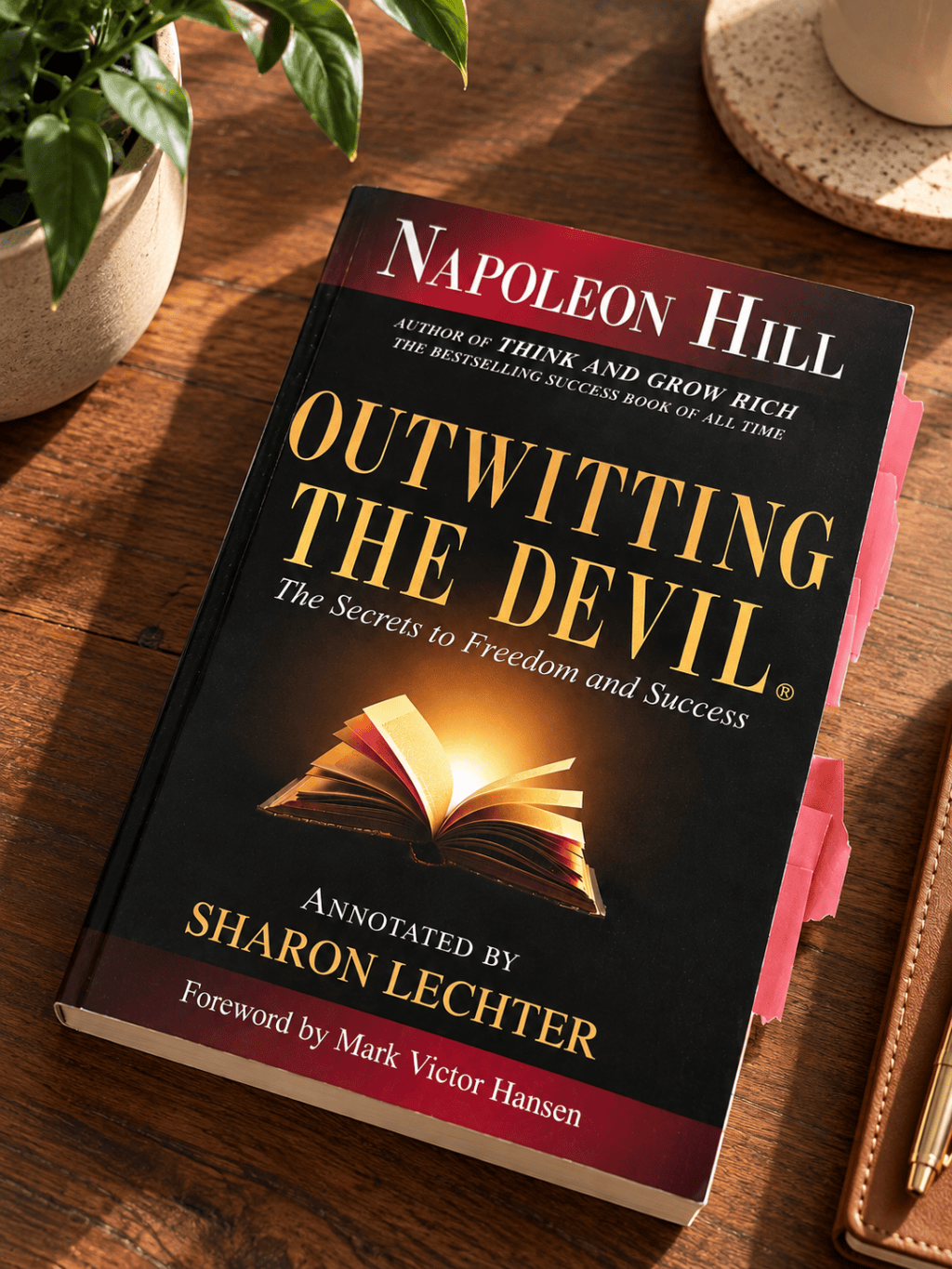
Have you ever read a book that made you stop, put it down, and genuinely question everything around you? That’s exactly how I felt reading Outwitting the Devil by Napoleon Hill.
I’ve read this book, returned to it dozens of times, and even listened to the entire audiobook. And somehow, every time I revisit it, I discover something that makes me think a little differently. I genuinely believe this is a book everyone should read at least once in their lifetime.
What makes it especially fascinating is that Napoleon Hill wrote it in 1938, yet so much of what he discusses feels incredibly relevant to the world we’re living in today. We’re talking about education, religion, marriage, fear, self-discipline, our environment, and the subtle ways we can lose control of our own thinking.
And here’s the really interesting part: the entire premise revolves around an interview with the Devil himself. Yes, you read that correctly.
An Interview With the Devil?
Before we get into the lessons, you need to understand how unusual this book is.
Napoleon Hill, best known for Think and Grow Rich, wrote Outwitting the Devil in 1938. However, the manuscript was considered so controversial that it wasn’t published until 2011, more than 70 years later.
The book includes an extraordinary imagined interview in which Hill interrogates the Devil, demanding that he reveal how he influences human behavior. The Devil, who insists on being addressed as “Your Majesty,” reluctantly answers Hill’s questions, often with a rather arrogant attitude. Their exchanges are fascinating, occasionally humorous, and sometimes downright unsettling.
Now, I want to make something clear. I don’t read this as proof that Hill literally sat down with Satan. I view the interview as a provocative literary device designed to expose the habits, fears, and influences that can keep people from living meaningful lives.
And as a Christian, I certainly don’t agree with every spiritual claim made throughout the book. But that doesn’t mean I can’t recognize valuable observations about human behavior. In fact, some of those observations absolutely blew my mind.
1. Drifting: Are We Actually Living, or Just Existing?
If I had to choose one of the most important concepts in this entire book, it would be drifting.
Hill’s Devil describes drifting as one of his greatest tools for influencing humanity. A drifter is someone who moves through life without a clear purpose, allowing circumstances, other people’s opinions, fears, and habits to determine their direction.
Think about that for a moment. How many people wake up every morning, reach for their phones, scroll through social media, go through their usual routines, and repeat the exact same patterns day after day? Weeks turn into months. Months turn into years. And before they know it, they’ve spent an enormous portion of their lives simply reacting to whatever happens around them.
They’re not necessarily doing anything terrible. They’re just not intentionally directing their lives. That’s what makes this concept so fascinating to me.
According to Hill’s framework, the Devil doesn’t always need some dramatic temptation to distract us from our purpose. Sometimes all it takes is keeping us busy, fearful, comfortable, or distracted enough that we never pursue what we’re truly meant to do.
As a Christian, this immediately makes me think about the importance of seeking God’s purpose for our lives. I believe God created each of us intentionally, with gifts, abilities, and opportunities to serve Him and others. But how can we fully pursue that calling if we’re constantly distracted?
Are we intentionally living the lives God has called us to live, or are we allowing the world to determine our direction?
That question alone makes this book worth reading.
2. Education, Religion, and the Ability to Think for Ourselves
This section was probably one of the most shocking parts of the book for me.
Hill challenges traditional education and organized religion, suggesting that institutions can sometimes encourage conformity rather than independent thinking. In the interview, the Devil claims that schools and churches can contribute to drifting when they fail to teach people how to think for themselves.
Now, before anyone misunderstands me, I absolutely believe education has tremendous value. Teachers can have an incredible impact on children’s lives, and schools provide opportunities for learning, friendships, structure, and personal development.
But I also believe there’s an important difference between teaching children what to think and teaching them how to think.
Are we encouraging children to ask questions, explore ideas, develop discernment, and think independently? Or are we sometimes teaching them to memorize information, follow instructions, and accept conclusions without questioning them?
Hill wrote about these concerns in 1938, and I find it fascinating that we’re still having similar conversations today.
His criticism of religion is equally thought-provoking. The book explores how religious institutions and disagreements can sometimes contribute to fear, division, and conflict. And honestly, as a Christian, this made me think.
How often do we see people arguing over denominations, interpretations, and theological differences while forgetting the importance of loving one another? Of course, doctrinal truth matters. I’m not suggesting we should ignore biblical teachings simply to avoid disagreement. But there’s a difference between respectfully discussing our beliefs and allowing disagreements to turn into hostility.
Jesus taught His followers to love one another (John 13:34–35).
For me, this section wasn’t a reason to abandon education or organized religion. It was a reminder to practice discernment, pursue truth, and never stop thinking critically.
3. Hypnotic Rhythm: The Habits That Quietly Shape Our Lives
Another concept that fascinated me was something Hill calls hypnotic rhythm.
In the book, this is the process through which repeated thoughts and behaviors become deeply established habits. Essentially, what we repeatedly think, believe, and do begins to shape the direction of our lives.
And doesn’t that sound familiar?
Think about how easily we develop routines without even realizing it. We wake up and immediately check our phones. We complain about the same things. We entertain the same negative thoughts. We spend time around the same influences. Eventually, those patterns begin to feel normal.
Hill describes hypnotic rhythm as a universal law. I wouldn’t personally treat that as an established scientific or spiritual law, but I do think the underlying observation about habits is powerful. Our repeated behaviors influence our future choices.
This reminds me of Romans 12:2, where Scripture speaks about being transformed through the renewing of our minds. As Christians, we’re called to examine our thinking rather than simply conform to the patterns of the world.
That doesn’t mean every thought magically creates our reality. But it does mean we should be intentional about what we’re allowing to influence our minds. Because the thoughts we continually entertain can affect the decisions we make, the habits we form, and ultimately the direction we take.
4. Your Environment and Relationships Matter More Than You Think
This might be one of my favorite sections of the entire book.
Hill explores how our environment influences our thoughts, particularly through the people we associate with most closely. He argues that we naturally absorb some of the attitudes, habits, and beliefs of the people around us. And I think there’s so much truth in that observation.
Have you ever spent time around someone who constantly complains? Someone who always sees the worst in every situation? Someone who makes you feel discouraged, anxious, or emotionally exhausted?
Now compare that with spending time around someone who is encouraging, kind, ambitious, faithful, and genuinely wants to see you succeed. The difference can be remarkable. We influence one another, often without realizing it.
But here’s where the book gets especially interesting.
Hill identifies the people who can have the greatest influence on our thinking, placing particular emphasis on our spouse, the people in our household, and those we work closely with.
Think about how significant that is when choosing someone to marry.
As a Christian, this immediately brought me back to Genesis 2:24, where marriage is described as two people becoming one flesh.
Marriage is more than simply sharing a home. You’re sharing decisions, responsibilities, conversations, struggles, dreams, and countless daily experiences. The person you marry can have an enormous influence on your emotional and spiritual environment.
That’s why I believe choosing a spouse deserves tremendous thought, prayer, and discernment.
And this applies beyond marriage. Your friendships matter. Your work environment matters. The content you consume matters. Even the conversations you participate in matter.
We cannot control every influence around us, but we can become more intentional about the environments we create and the relationships we nurture.
5. The Three Appetites That Can Destroy Self-Discipline
This section made me think about today’s society almost immediately.
Hill identifies three appetites that people must learn to master:
- The desire for food.
- The desire for sexual expression.
- The desire to express loosely formed opinions.
Now tell me that isn’t relevant today!
We live in a world where overconsumption is practically encouraged. Food is available everywhere. Sexual content is increasingly accessible. And social media has given nearly everyone a platform to share an opinion about absolutely everything.
Let me be clear: food, sexuality, and having opinions are not inherently bad. But there’s an enormous difference between enjoying something appropriately and allowing it to control you.
Take food, for example. How often do we eat because we’re bored, stressed, upset, or simply because something tastes good, even when we’re no longer hungry?
Or consider the way sexual intimacy is sometimes treated as casual entertainment rather than something deeply meaningful. As a Christian, I believe sexuality carries significance and responsibility. It’s not something I think we should treat carelessly.
And then there’s the third appetite. Oh my goodness, the opinions!
Everyone seems to have something to say about everything. Social media can turn even the smallest disagreement into an argument between complete strangers. Sometimes I wonder how much healthier our conversations would be if we spent more time listening, learning, and trying to understand one another instead of constantly needing to prove we’re right.
This section reminded me that self-control isn’t about depriving ourselves of everything enjoyable. It’s about having the discipline to decide what deserves our time, attention, and energy.
Galatians 5:22–23 identifies self-control as part of the fruit of the Spirit. And I think that’s a beautiful reminder that freedom isn’t always found in doing whatever we want. Sometimes freedom comes from no longer being controlled by every desire we experience.
6. Marriage, Prayer, and Where My Christian Beliefs Differ
There are two particular discussions in this book that really made me stop and think.
The first involves marriage.
During the interview, Hill questions the Devil about unhappy marriages and whether people should remain together when their relationship is filled with conflict. The Devil challenges the traditional idea that every marriage is made in heaven, suggesting that some relationships can become sources of disharmony and drifting.
I found this fascinating, but it’s also an area where I have to be careful.
As a Christian, I believe marriage is a sacred covenant. I also believe God can restore relationships that seem completely broken.
That doesn’t mean every marriage will be restored, nor does it mean someone should remain in an unsafe situation. But I wouldn’t take the Devil’s statements in this book as spiritual authority on marriage.
The second discussion involves prayer.
Hill’s Devil suggests that many people approach prayer from a place of fear and uncertainty rather than faith and definite purpose. He also criticizes people who expect their problems to disappear without taking responsibility for their own actions.
And I have mixed feelings about this.
On one hand, I absolutely believe faith and action belong together.
If we’re praying for a healthier life, shouldn’t we also make an effort to care for our bodies? If we’re praying for financial stability, shouldn’t we practice wisdom and responsibility with our money? If we’re praying for a stronger marriage, shouldn’t we also be willing to communicate, forgive, and grow?
James 2:17 reminds us that faith without works is dead.
But here’s where I disagree with Hill’s philosophy.
I don’t believe prayer is simply a technique for turning our desires into reality.
I believe prayer is communication with a living God who loves us, hears us, and knows far more than we do.
Sometimes His answer is yes. Sometimes it’s no. And sometimes it’s not yet.
I don’t believe an unanswered prayer automatically means someone lacked enough faith or allowed fear into their mind.
God isn’t a formula. And although I believe we should approach Him with faith, I also believe His wisdom is greater than our understanding.
That’s why I think this book requires spiritual discernment. There are meaningful insights about responsibility, discipline, and purpose, but not every explanation aligns with biblical Christianity.
And that’s okay. We can learn from someone’s observations without accepting every part of their worldview.
7. Definiteness of Purpose: The Most Important Lesson of All
If there’s one message I hope you take away from this book, it’s the importance of having a definite purpose.
Hill repeatedly emphasizes that people who know what they want and intentionally pursue it are less vulnerable to drifting. And I absolutely love this concept.
How often do we spend our lives chasing things simply because society tells us they’re important? A certain career. A certain lifestyle. A certain level of success. A certain image of what our lives should look like.
But have we ever stopped to ask whether those things actually align with who we are and what we believe?
For me, as a Christian, this goes even deeper. I don’t simply want to create a life that looks successful from the outside. I want to live a life that reflects the purpose God has for me.
I want to use the gifts He’s given me. I want to be intentional with my time. I want to grow spiritually, emotionally, mentally, and physically.
And I don’t want to wake up years from now wondering why I spent so much time distracted by things that never really mattered.
Proverbs 16:9 reminds us that we can plan our course, but the Lord establishes our steps.
I love that balance.
We have a responsibility to make choices, develop discipline, and pursue meaningful goals. But ultimately, I want God directing my path.
Not fear. Not society. Not comparison. And certainly not the endless distractions competing for our attention.
My Final Thoughts: Is Outwitting the Devil Worth Reading?
Absolutely.
I’ve read this book, listened to it, and returned to it repeatedly because it challenges me to examine how I’m living. And that’s what I love about a good book.
It doesn’t necessarily need to confirm everything you already believe. Sometimes the most valuable books are the ones that challenge you to think more deeply.
I don’t agree with every spiritual concept Napoleon Hill presents, and I certainly wouldn’t recommend replacing biblical teaching with his philosophy. But I do think his observations about drifting, fear, self-discipline, relationships, and independent thinking are worth exploring.
What amazes me most is that he was writing about these subjects back in 1938. Long before smartphones. Long before social media. Long before we could spend hours scrolling through other people’s lives.
Yet here we are, still wrestling with so many of the same questions about influence, distraction, discipline, and purpose.
Maybe that’s because human nature hasn’t changed nearly as much as our technology has. And perhaps that’s what makes this book so fascinating.
It forces us to ask ourselves a question that I think we should all consider:
Am I consciously directing my life toward what matters most, or am I slowly drifting away from the person God created me to be?
Because ultimately, I don’t want to simply go through the motions of life. I want to live intentionally. I want to think for myself. I want to choose my influences carefully. And above everything else, I want to pursue the life God has called me to live.
If you haven’t read Outwitting the Devil, I genuinely encourage you to give it a chance. Read it with an open mind, question what doesn’t align with your beliefs, and take time to reflect on the ideas that challenge you.
You might be surprised by how much a book written nearly 90 years ago makes you reconsider the world you’re living in today.
Have you read Outwitting the Devil? I’d love to know which part challenged your thinking the most.
“Trust in the Lord with all your heart; do not depend on your own understanding. Seek his will in all you do, and he will show you which path to take.”
Proverbs 3:5-6




Leave a Reply